Space Debris · Satellite Reentry · Orbital Sustainability
A Crowded Sky: Why Space Debris Keeps Growing
Space debris keeps building up even as more satellites return to Earth. In 2025, about ten new payloads went into orbit each day, while more than three intact satellites or rocket bodies reentered the atmosphere. [1] The two figures leave out what can happen in between, when a spacecraft breaks apart in orbit.
4 min read
In September 2019, engineers in Germany sent a series of commands to a satellite that measured the Earth’s winds. There was nothing wrong with its instruments. Another spacecraft, part of SpaceX’s Starlink constellation, was due to pass close enough that the European Space Agency (ESA) put the chance of a collision at about one in a thousand. Aeolus fired its thrusters, lifting its orbit by roughly 350 metres. About half an hour after the two satellites were due to pass, Aeolus radioed home on schedule. [2]
Aeolus could move because it was still working and had fuel. A dead satellite occupying the same stretch of orbit would have left the other spacecraft to do the manoeuvring, if it could. That difference helps explain why ESA pays attention to what happens to satellites at the end of their working lives.
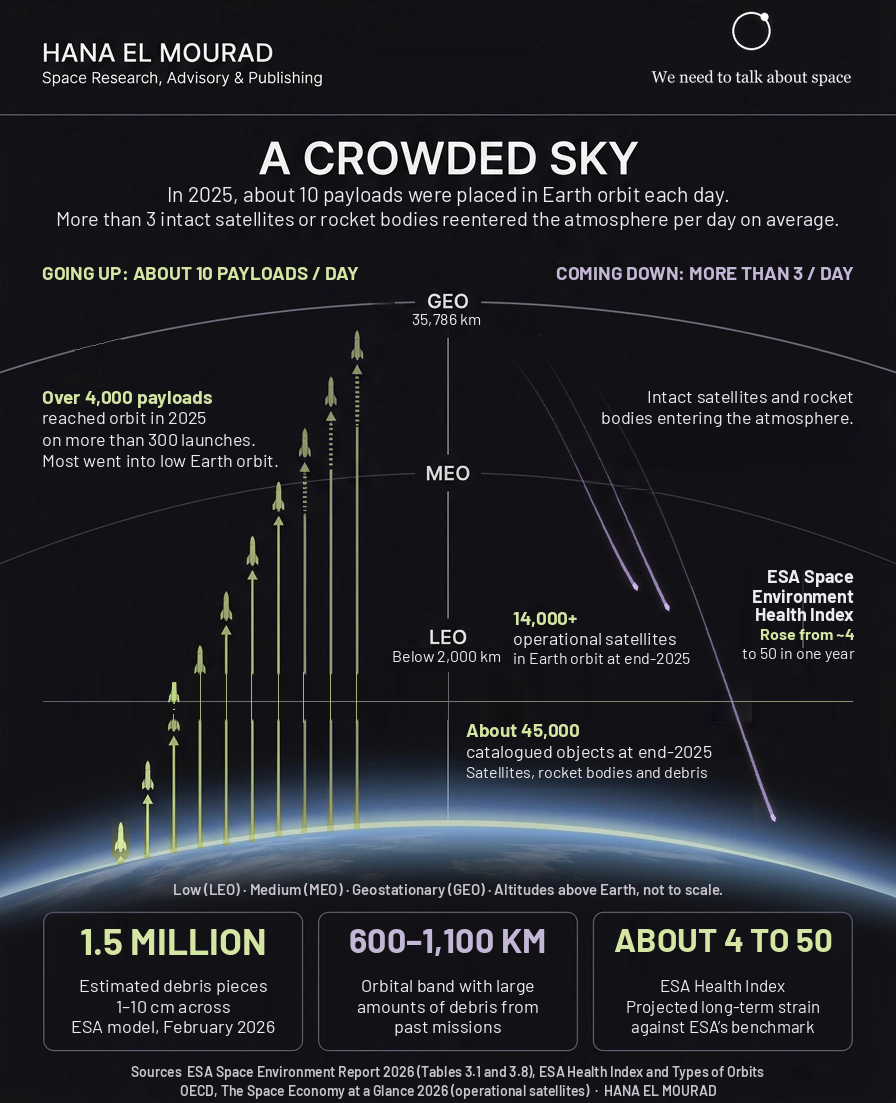
The infographic compares 2025 launches and reentries with the objects ESA catalogued in Earth orbit at the end of that year. [3] The OECD counted more than 14,000 operational satellites at end-2025. [4] The estimate for debris measuring 1–10 cm comes from ESA’s February 2026 model. [5] Open the full-size infographic
Infographic by Hana El Mourad.
| What ESA counted | Daily average |
|---|---|
| New payloads placed in orbit | About 10 |
| Intact satellites or rocket bodies reentering the atmosphere | More than 3 |
What Happens When a Satellite Reenters?
A satellite in low Earth orbit gradually loses altitude as it encounters traces of the atmosphere. An operator can sometimes speed up that descent or steer the spacecraft so any pieces that survive reentry are more likely to fall away from populated areas. [6] ESA’s 2026 report found that controlled reentries of rocket bodies outnumbered uncontrolled ones in 2025 for the second year running.
The two daily averages count different things. In that report, ESA counted more than 4,000 payloads placed in orbit on more than 300 launches in 2025. A single rocket can carry a batch of satellites. The reentry figure counts intact satellites and rocket bodies. It leaves out fragments, including those created when a spacecraft breaks apart in orbit. Subtracting one daily average from the other would tell us little about how much debris accumulated.
Why Is Space Debris Still Increasing?
In 2009, Iridium 33, an active communications satellite, collided with the defunct Russian satellite Kosmos 2251 above Siberia. The impact destroyed both spacecraft and produced more than 2,000 trackable fragments. Each piece that remains in orbit can cross the path of another spacecraft. If those fragments cause further collisions and generate still more debris, the process can feed on itself. This is known as Kessler syndrome. [7]
ESA’s Space Environment Health Index rose from about 4 to 50 in a year. The index compares projected long-term strain on the orbital environment with a sustainability benchmark. A rise in the score means today’s activity could leave future missions with a harder environment to operate in. [8]
When a satellite stops serving the people who launched it but can still put other spacecraft at risk, how long should its operator be responsible for it?
How Can Operators Reduce Collision Risk?
Nearly four years after Aeolus moved out of Starlink’s path, ESA used its remaining fuel to guide it towards reentry. The spacecraft entered the atmosphere above Antarctica in July 2023. The manoeuvres were designed to reduce the chance that any surviving pieces would reach populated areas. [9]
The first manoeuvre kept Aeolus working. The last got it out of the way of future missions. Older spacecraft that can no longer manoeuvre pose a harder problem, which is why ESA sees a role for active debris removal alongside better disposal of new satellites. [10]
The Sky We Leave Behind
At dusk, you can sometimes see a satellite cross the stars, still catching sunlight after the ground has gone dark. In a long exposure, that brief crossing can leave a bright line across an astronomer’s image. [11]
From up there, other satellites look back at Earth, taking measurements that help us make sense of a changing climate. A climate record that spans decades depends on successive satellites carrying on the same measurements. [12] The next satellite may have to do that in an orbit where fragments from spacecraft launched years earlier are still circling.
A decision about what goes into orbit is also a decision about what stays there and what people on Earth see when they look up. Before we approve another fleet of satellites, how much should we ask its operator to do to keep those orbits usable and the night sky dark?
References
- ESA (2026). Space Environment Report 2026
- ESA (2019). ESA spacecraft dodges large constellation
- ESA (2026). Space Environment Report 2026, Objects orbiting Earth, Table 3.1
- OECD (2026). The Space Economy at a Glance 2026
- ESA. Space Environment Statistics (February 2026 MASTER-8 debris estimates)
- ESA (2018). Basics about controlled and semi-controlled reentry
- ESA. About space debris
- ESA (2026). Space Environment Health Index
- ESA (2023). Right on track: Aeolus reentry mapped and Preparing Aeolus’s assisted reentry
- ESA. Active debris removal
- International Astronomical Union CPS (2024). Call to Protect the Dark and Quiet Sky from Harmful Interference by Satellite Constellations
- ESA. Overview of the Climate Change Initiative